
|
|
| Re: The Brooklyn Trolley Dodgers (191724) | |||
 |
|||
| Home > OTChat | |||
|
[ Read Responses | Post a New Response | Return to the Index ] |
|
||
|
Re: The Brooklyn Trolley Dodgers |
|
|
Posted by salaamallah@hotmail.com on Thu Feb 8 22:00:59 2007, in response to The Brooklyn Trolley Dodgers, posted by GP38/R42 Chris on Thu Feb 8 19:21:41 2007. too bad this has been forgotten ........---------- http://www.pbs.org/independentlens/chavezravine/ -------------------------   In 1949, photographer Don Normark visited Chavez Ravine, a close-knit Mexican American village on a hill overlooking downtown Los Angeles. Enchanted, he stayed for a year and took hundreds of photographs documenting community life. But little did Normark know that he was capturing the last images of a place that was about to disappear—within a few short years, the entire neighborhood would be gone. CHAVEZ RAVINE: A Los Angeles Story tells the story of how this Mexican American community was destroyed by greed, political hypocrisy and good intentions gone awry. During the early 1950s, the city of Los Angeles forcefully evicted the 300 families of Chavez Ravine to make way for a low-income public housing project. The land was cleared and the homes, schools and the church were razed. But instead of building the promised housing, the city—in a move rife with political controversy—sold the land to Brooklyn Dodgers baseball owner Walter O’Malley, who built Dodger Stadium on the site. The residents of Chavez Ravine, who had been promised first pick of the apartments in the proposed housing project, were given no reimbursement for their destroyed property and forced to scramble for housing elsewhere. Fifty years later, filmmaker Jordan Mechner explores what happened, interviewing many of the former residents of Chavez Ravine as well as some of the officials who oversaw the destruction of the community. Narrated by Cheech Marin and scored by Ry Cooder and Lalo Guerrero, CHAVEZ RAVINE combines contemporary interviews with archival footage and Normark’s haunting black-and-white photographs to reclaim and celebrate a beloved community of the past. Launch photo album >> In 1949, photographer Don Normark captured the black-and-white photographs that would later be featured in CHAVEZ RAVINE: A Los Angeles Story, as well as in his book Chávez Ravine, 1949. Unknowingly at the time, Normark’s portraits of Chavez Ravine’s residents illustrated a community whose days were numbered. Within a few years, the close-knit village would disappear, replaced by a new Dodger Stadium. From children playing in the open hills to multi-generational families mingling with neighbors, Normark’s photographs illustrate daily life in a lost community. The Flash 6 plug-in is required to view this feature. Download Flash player plug-in. Music excerpt from the CHAVEZ RAVINE original score by Ry Cooder. Photos courtesy of Don Normark. ------------- 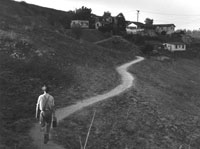 Chávez Ravine A Los Angeles Story Don Normark's haunting photographs bring back to life a Mexican American village razed in the 1950s to build Dodger Stadium. 24 minutes DVD-R version available (Classroom Version available with bleeped track in a few places.) Color / Stereo Closed Captioned Grade Level: Grades 4 to 12, College, Adult US Release Date: 2005 Copyright Date: 2004 ISBN (VHS): 1-59458-245-9 ISBN (DVD): 1-59458-246-7 Directed by Jordan Mechner Produced by Jordan Mechner, Don Normark, Andrew B. Andersen, Mark Moran Photographs by Don Normark Music by Ry Cooder Narrated by Cheech Marin "Heartfelt... well-shot and sharply edited" Microcinema Scene CHAVEZ RAVINE tells the bittersweet story of how an American community was betrayed by greed, political hypocrisy, and good intentions gone astray. In 1949, photographer Don Normark stumbled on Chávez Ravine, a closely-knit Mexican-American village on a hill overlooking downtown Los Angeles. Enchanted, he stayed for a year and took hundreds of photographs, never knowing he was capturing on film the last images of a place that was about to disappear. The following year, the city of L.A. evicted the 300 families of Chávez Ravine to make way for a low-income public housing project. The land was cleared, homes, schools, and church razed to the ground. But the real estate lobby, sensing a great opportunity, accused the LA Housing Authority's Frank Wilkinson of being a communist agent. The city folded and instead of building the promised housing, it sold the land to baseball owner Walter O'Malley, who built Dodger Stadium on the site. Fifty years later, Normark's haunting black-and-white photographs reclaim and celebrate a lost village from a simpler time. DVD version: Chávez Ravine contains two versions of the film, the original version and a slightly expurgated version for classroom use, where a few swear words are bleeped out. The DVD version of this program is recorded on DVD-R which is not compatible with some older DVD players. See the new DVD page for more details. -------------------------------------------------------------------------------- Awards: Short-listed for Best Documentary Short, Academy Awards® National PBS Broadcast on "Independent Lens" Best Short Documentary, International Documentary Association Awards Gold Plaque, Chicago International Television Awards Grand Jury Award for Best Documentary Short, Florida Film Festival Unique Award, Society for Visual Anthropology Film & Video Festival Honorable Mention, Columbus International Film & Video Festival Award for Community History, Visual Anthropology Film Festival Margaret Mead Film Festival Full Frame Documentary Film Festival InFact Documentary Theatrical Showcase Tribeca Film Festival AFI Film Festival Kodak DocuFest IFP Market Hot Springs Documentary Film Festival Vermont International Film Festival United Nations Association Film Festival, Stanford Silver Lake Film Festival Artivist Film Festival Hazel Wolf Environmental Film Festival Roxbury Film Festival Fact vs. Fiction Film Festival Cine Las Americas, Austin National Association for Multicultural Education Conference Reviews: "Heartfelt... well-shot and sharply edited... it's Mechner's sense of people and place, more than moral outrage, that makes his work compelling. ***" MicrocinemaScene "This bittersweet tale recounts a lost village, Dodger Stadium, and the miraculous moment of time that lay between them." Florida Film Festival Program "Powerful and moving... a gripping revival of the forgotten history behind the land which today holds L.A. Dodger Stadium." The Daily Sundial, California State University "Using historic photographs of the families as well as contemporary interviews -- and with a surprising twist -- Mechner tells a cautionary story of community, deception, and loss." Full Frame Documentary Film Festival Program "Chavez Ravine is a unique and fascinating contribution to the unknown history of Latino people in California. It relates beautifully to every dislocated community; it connects in a surprising and important way to the McCarthy Era; it is composed of oral history and historic photographs, woven seamlessly with a beautiful score and narrative. I cannot recommend it highly enough to all teachers because it shows the relevance and power of history for all. My own students raved about it." Lauren Coodley, History Dept., Napa College, Author of Napa: the Transformation of an American Town and Land of Orange Groves and Jails: Upton Sinclair's California "Chavez Ravine is a poignant and painful look at race, politics, and displacement in Los Angeles. This documentary tells the story of Mexican communities that were removed first by City Hall and then, by the L.A. Dodgers. The film, though, also tells a story of memory and resistance as the publication of old photographs brings people together and in some ways keeps the communities of Chavez Ravine alive. This film would be ideal for courses dealing with communities of color, urban politics, race, and the politics of memory." Maria Elena Garcia, Asst. Prof. of Anthropology, Sarah Lawrence College "Chavez Ravine is an important work of historical recovery that visually retrieves a strand in the lost history of Los Angeles. It is a beautifully produced account of the human costs of urban displacement and of the complexities of urban politics." Michael Kowalewski, Carleton College "The villages are gone, they survive only in memory, and in this wonderful...film...Highly recommended." David Kidney, Greenman Review "A fascinating assembly of Normark's photographs of a community lost in time and mind...Highly recommended. Brad Eden, Ph.D. University of Nevada, Las Vegas for Educational Media Reviews Online "An eerie foreshadowing of today's 'eminent domain' debate about the use of private property for the public good...this revelation of a shameful episode in Los Angeles history is illustrated with the hauntingly evocative pictures of acclaimed photographer Don Normark...recommended." Video Librarian |
|
|
|